Month: June 2011

  • A Watt is not a Watt, What?

    I’ve just started to work with sound for the first time. Oh, I’ve dabbled a little bit in the record-able birthday card arena, built a couple of embedded amplifiers and a filter (strong word for a capacitor) or two, but I’m pretty clueless when it comes to the sound lingo.

    The HeartBeat Dome project requires two speakers, one that runs all the time and the other that spits out heartbeats. My project partner Lex found this perfectly sized (4″ diameter, 8″ length) speaker on eBay to run the all-the-time sound.
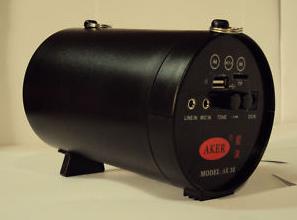
    speaker aker

    The speaker’s specifications say 25 Watt Peak Power Output.
    As an electrical person, I took this spec to mean Maximum power output 25 Watts at full volume.
    I have no idea what 25 Watts sounds like, but Lex reminded me how loud his high school band was with a 40 Watt amplifier.
    Since I am doing some power supply design that encompasses all the speakers, it is necessary to know exactly how much power the speaker consumes.
    So I plug the AC to DC converter wall wart into the power strip and from the DC side of the wall wart, I measure 9.5 Volts and something like 250 mA. Which V*A = just under 3 Watts input. Hm. Confusion. Really? You can put 3 Watts in and get 25 watts out? Further research shows there is a battery inside the speaker, so without the AC wall wart using up all the power, the battery can theoretically at optimal condition, put out 2A / 7.5V. Still, this is 15 Watts…not the advertised 25.

    So I write to the company and get this back:

    Dear Sophi,
    The power is described as the peak output power 25 watts. If we just
    calculate the power by volts and the current, then it cannot be
    25watts. What’s more, our techinican also specified about the power. I
    once have told him about this issue, it can be explained as the above.
    Have a nice week.
    Best regards,
    XXX

    OK…now I’m annoyed. Is it possible that Electrical Watts are different than Audio Watts?
    I’m sure you all know the answer to this. A unit is a definition. So all Watts are Watts.
    Electrical Watts are quite easy to calculate, but Audio Watts less so.

    I grabbed the following awesome example from Crown Audio.

    Example: You are designing a system where the farthest listening position from the loudspeaker is 100 meters, and the desired Sound Pressure Level is 85 dB SPL The loudspeaker chosen for the job has a sensitivity rating of 95 dB. With the minimum recommended amplifier headroom of 3 dB, then you need to choose an amplifier that can supply at least 1,995 watts to the loudspeaker.

    Equations used to calculate the data:

    dBW = Lreq – Lsens + 20 * Log (D2/Dref) + HR

    W = 10 to the power of (dBW / 10)

    Where:
    Lreq = required SPL at listener
    Lsens = loudspeaker sensitivity (1W/1M)
    D2 = loudspeaker-to-listener distance
    Dref = reference distance
    HR = desired amplifier headroom
    dBW = ratio of power referenced to 1 watt
    W = power required

    So moving forward, I have another speaker, a subwoofer-amplifier-powered deal that is about 1.5 cubic feet and rated at 80 Watts. I go through the same routine again, measuring the voltage and current input. I get just about 35 Watts input. The input power is related to how loud my signal is. I ask a friend to record me something at an insanely loud amplitude but I can’t get the input power over 43 Watts.
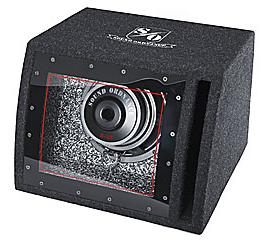
    sub

    I’m guessing these specs are a marketing trick by people who are math clueless. And if you really can get more power out of an audio amplifier than you put in, Global Energy Crisis= SOLVED!

  • HeartBeat Dome and the path to creativity

    It’s time for a new project again. The new project will be designed for Burning man Festival in Black Rock City, Nevada. I’m working with three other people on this one, and it’s working out really well. Two of the people live 3,000 miles away from me so designing something over email and texting is a new experience for me. Working virtually really focuses things because everything important is written down and we don’t spend so much time “hanging out” instead of working.

    The project is called HeartBeat Dome and it triggers on your own heartbeat. The concept is cool because hey, everyone has a heartbeat, which means that everyone can relate to it.
    Here’s the link for a formal description and a couple of images of the proposed HeartBeat Dome.

    Many conversations center around what is creativity and how to get more of it. I define creativity as an unusual way of solving a problem. The problem can be as basic as making a peanut butter and jelly sandwich or as esoteric as “what am I going to create?”. This last (very difficult) question encompasses the whole universe since nothing is impossible and you’re only limited by your own mind.
    There is a lot less need for creativity when you have limits.
    Take the peanut butter and jelly sandwich for example. By definition, there are only three ingredients. The only choices are choosing the brand and type of peanut butter (organic? smooth? added sugar?), jelly (strawberry? apricot?) and bread (toasted? grain? Wonder?).
    If you want that sandwich right now, you are further limited by what is available in the immediate area.

    PB&J

    So how do you answer more difficult questions? Creativity is by no means limited to things that fall in the artistic range. For example, creativity is used to solve medical, mathematical and all different kinds of problems.
    How do you cure cancer? How do you grow longer eyelashes? How do you write a mathematical algorithm that will do your taxes? What about writing a Smart phone app?
    All of those things need creativity, out of the box thinking, the ability to grab a problem and solve it with undefined things.
    I went searching online for what defines a creative person and found many discussions of this topic. The reason that it is so important is because there are always new problems to be solved, in business, in life, in art. The world needs creativity to move forward.

    So how do you get more of it? Here is a little bit about my process.

    My creative process is typically to think of the problem and work backwards to solve it. I’ll come up with the vision, as complicated as my imagination wants it to be. I don’t get sucked into negativity as in “that won’t work, that’s too hard, that will cost too much money”. Those are details that hamper my creativity personally. I might have the capacity to dream up a Giraffe petting zoo, but that doesn’t mean I can or need to make it happen.

    Visualization without limits trains your mind to be more creative!

    Once I have the vision hammered out, I’ll write in words a summary of what it is. Then it’s time for details. And I’m not afraid or too prideful to give up on something before it gets started. Why work on something that isn’t going to be fun to work on?
    Creativity takes practice. One of my uncles wrote a book called the ABCs of Business and it has this great advice of taking a walk every morning for 2 hours. No iPod, no dog, no companion. When you are truly alone, you focus your mind entirely. I had never even considered doing this before I read his book, but now I try to do this every morning for 25 minutes. It really helps.

    What if you crave creativity but have gotten comfortable with the Peanut Butter and Jelly sandwich limits? Narrow down your choices. If it’s a building project and it requires paint, make it require only one choice, warm color or cool color. Ultimately it matters more that you do it than what decision you make.

    There is also a lot to be said for Getting ‘Er Done. Coming up with visions, ideas and plans takes a lot of effort. I have gotten really comfortable with failure, a byproduct of coming up with big ideas and plans.
    I have the occasional month or two where I’m just not feeling it. I get through those times by pretending that I do feel it. Fake it til you Make it is the best advice I have for anyone trying to jumpstart their own creativity.


  • Finger Pulse Oximeter!

    Check back for more posts on the Oximeter. Here’s the link for the Maker Faire recap.
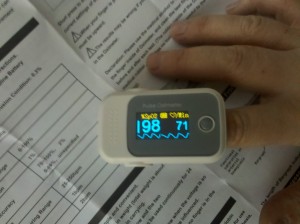
    I ordered a finger pulse oximeter online, which was waiting for me on my porch when I got home yesterday.

    oximeter working

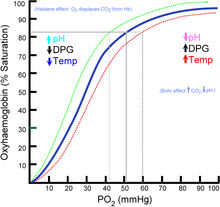
    A pulse oximeter measures a couple of important human body functions- the heart rate and hemoglobin oxygen saturation. Heart rate monitoring is important for heart problem detection, and oxygen saturation levels can indicate respiratory problems. For the record, a normal resting heart beat is between 60 and 100 beats per minute… a heart beat on the low end of normal indicates an efficiently running heart. A normal hemoglobin oxygen saturation percentage is between 95 and 100%. Simply put, this means how easily does hemoglobin transfer oxygen molecules into and out of its surrounding fluid.

    Want to know more about this?

    Ox

    The way this Oximeter works is really interesting. There are two LEDs, each sending out light of differing wavelengths, facing a photodiode (converts light to current). You put your finger in between the LED and the photodiode.
    The blood vessels expand and contract with each heartbeat, and the pertinent signal bounces in time, allowing the heart rate to be calculated. The oxyhemoglobin ratio is calculated from the absorption of the light ratio of the two differing wavelengths.
    Of course I had to open it up.

    v

    And then a little more.

    v

    So it’s now broken since I unfortunately snapped the ribbon cable keeping the two halves together. Even though I soldered it back together, it will only power on and does not work anymore 🙁
    It is powered by a STM32F103C8T6 with a 8MHz crystal.
    …I just ordered two more.