Month: July 2011

  • Microprocessor-driven relay

    Problem: I have a 12VDC fan that needs to be switched on and off. It’s a pretty windy fan with an Endless Breeze label on it, claims to be 900CFM and uses 36Watts.

    Problem: I’m using a microprocessor (PIC16F877A if you must know) to switch the fan on and off.

    The fan needs about 3A to switch. The microprocessor isn’t capable of sourcing or sinking very much current, only about 25mA, which is not even close to what the fan needs.

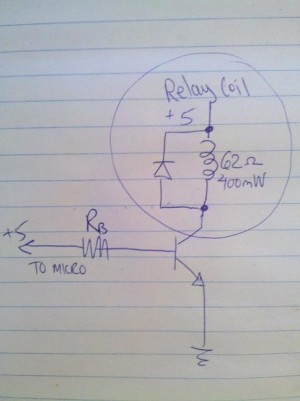
    Here’s a quick sketch of what the pin of the microprocessor connects to. Since the relay coil needs 400mW to energize, at 5V, that’s 80mA needed. Notice there is a flyback diode in my sketch. You always need that, otherwise when the relay switches off, current can come back into the circuit and let the magic smoke out of something.
    Here’s a standard circuit of a BJT transistor switch:
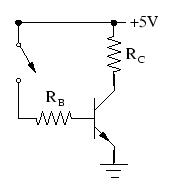
    Rc is the resistance of the relay coil (62ohms) so the current flowing through the coil will be 5V/62ohms = 80mA.
    When you choose your transistor, there is a specification called hFE , which is the current gain of that particular transistor. I suppose a bigger gain is better, but I’m just going to use what I have lying around and hope it’s enough.
    I have a 2924 NPN transistor, and the hFE is 100. Therefore, I need to have 0.8mA minimum to switch the relay coil. The microprocessor can easily do this, so I am happy. Rb maximum should be 6.25k (5V/0.8mA). If I go a little smaller, that will be OK too, since it would be good if there is extra current in case the hFE isn’t exactly 100.

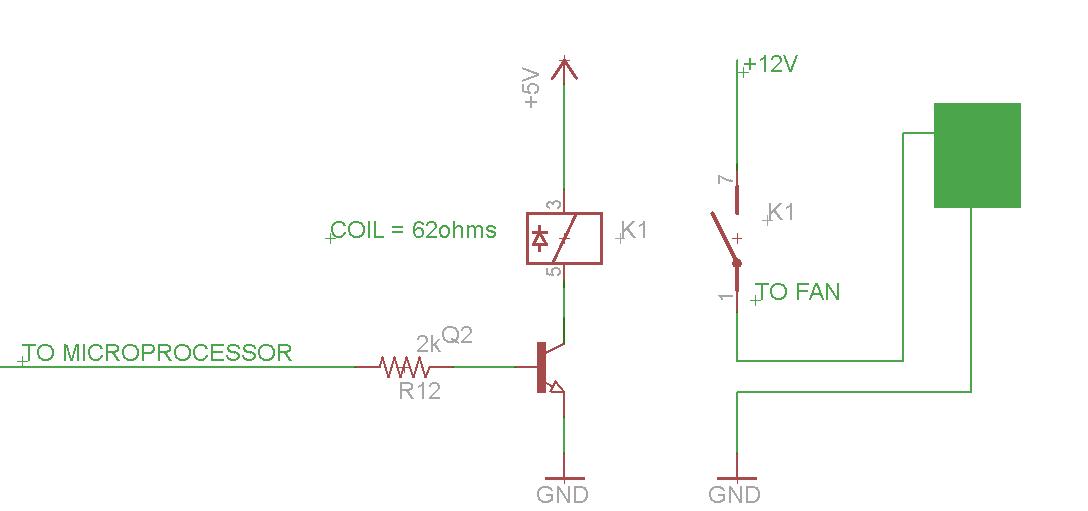
    Here’s the circuit. Email me if you have any questions!


  • Theo Jansen’s Strandbeest

    This…you have got to see.

    .

  • Kickstarter = inventor funding

    Kickstarter is a micro-investing website where you can post a project and ask the online world (and your friends and family) for funding.
    The project you post has to be a “doing” project. Kickstarter doesn’t accept “fund my life” fundraisers.
    Some of the projects asking for funding are Product Design projects. This is great because you can do your market research while you ask for backers. If the Product Design project isn’t backed, it could be a conclusion that it is unlikely to sell. Every project offers backer rewards. Many of the Product Design projects offer a first run of the product.
    Better to find out that the world outside your head doesn’t want to buy it before you invest a lot of time and money into engineering and manufacturing it.

    I just backed this project: an Upstate NY artist, Zac Shavrick, is making steel sculptures of people. Weird, monster-y sculptures. YEAH! I love it!


  • Pianococktail – a piano that plays drinks!

    I have only seen the Pianococktail once, at an ITP student show (2008) at NYU, in New York City.
    It is a piano whose keys actuate solenoids that open valves to bottles containing drink mixtures, Red Bull, alcohol and soda.
    Whatever song you play will mix its own special drink.
    I’ve always thought this was one of the most innovative pieces I’ve ever seen and have never forgotten it. I Googled the artist, Geraldine Schenkel today, and was disappointed to find little information on her. The Piano Cocktail site is in French, but Google Translate takes care of that if you don’t speak it.

    Here’s a little (translated) blurb from the site:
    The pianocoktail is a bar above all: that the pianist plays, it is necessary that people drink. The piano does the rest. A trill in a position to mix the rum syrup, cane sugar and the dose of tequila will be discharged by an F sharp.
    Each has its own cocktail music: you choose an alcohol. Or melody … (see menu) and passes control to the pianist.
    There are non-alcoholic cocktails for children and pregnant women.
    And for the purposes of the evening, you can taste the coffin: a gutter that gets the wrong notes, stray bullets, lost doses of vodka and ginger juice spurts …

    Here’s a video: